What is Spiritual Communion?
- David Martins

- Mar 26, 2020
- 5 min read
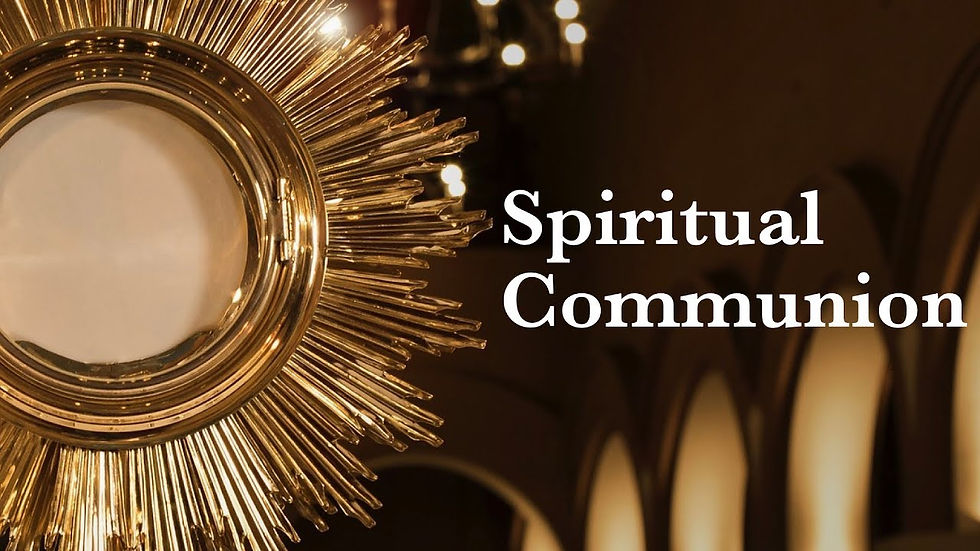
During these days of COVID-19 craziness, as we well know, Catholics across the globe are figuring out how to practice their Eucharistic faith in light of the inability to go to Mass. Priests have taken to the internet and Social Media to provide digital gatherings of public prayer – in short, the Body of Christ has been mobilized to think outside the box, and do whatever it takes to come together. Thank you to our priests who are exercising such dedication to their vocation!
Around different blogs and articles I have seen an ongoing reference to “spiritual communion”, since we are unable to enter into sacramental communion with the Lord in the Eucharist. I think it’s worth our consideration to delve a little deeper into this concept and recognize an important truth: they are most definitely two different things, but when we are again able to come into sacramental communion, that doesn’t mean spiritual communion goes out the window! Really, spiritual communion shouldn’t be anything new for us!
If you look around your local Parish Church while walking back to your pew after communion you most likely see many people stooped in prayer – earnest looking prayer – making use of this precious time between the individual and Jesus. In truth though, that time is not about “me and Jesus” it’s about “us with Jesus”…it’s about the Body of Christ, of which each of us are members, and Jesus himself is the head.
We frequently use the word “communion” to describe the host that we receive, that has been consecrated by the priest and changed into the body and blood, soul and divinity of Jesus. Strictly speaking, communion has a much more dynamic meaning.
Cardinal Ratzinger says that the beginnings of an explanation of the concept of communion can be found in 1 John 1:3 where it reads: "That which we have seen and heard we proclaim also to you, so that you also may have fellowship with us; and our fellowship is with the Father and with his Son Jesus Christ. And we are writing this that our joy may be complete".
Communion with Christ begins in the encounter with the Son of God, Jesus Christ, who comes to us through the Church's proclamation. God comes to us in the flesh in Christ, to stir up communion with his people: he becomes one of us, so that we can be in a true, and experiential communion with him. That realization opens for us the doors to communion. The end goal of communion is that “our joy may be complete”, which will happen fully in the life to come. By our Baptism, our very being is bound to this entire reality. This is how we share in the communion of Saints: the fellowship of the Baptized of the past, present, and future – in short, we are, across time and history- the Body of Christ.
In the Eucharist Christ builds the Church: he nourishes the body. In the elements on the altar he gives himself ever anew, and through his risen body he unites us to the Trinity and to one another (for more on all of this, see Ratzinger’s Pilgrim Fellowship of Faith, in the section on “The Ecclesiology of the Constitution Lumen Gentium”).
Spiritual communion then is not anything new for us- it should be part of our overall communion experience already! We spend our days seeking fellowship with God, through a myriad of ways, and when we approach the altar to be nourished in that communion we declare “amen” to express our assent to the Father’s will for us, to assent to our role in the body, and to affirm our belief in that which we receive. The communion among us, with Christ as our head, is built up, affirmed, and expressed in the Eucharist we share. Our prayer when we go back our pew is for us to come to a deeper experience of communion with Christ and with one another. It's a time of awakening to the reality of the communion we share!

We find a beautiful model of these concepts in the Solemnity the Church celebrated yesterday of the Annunciation. The beginnings of the infancy narrative tell us the story of the Virgin’s encounter with Gabriel, her visit to Elizabeth, and the subsequent events in Bethlehem. Mary’s “yes” is our “Amen” – she had already built up for herself a fellowship with God through her life as a faithful Jew, awaiting the coming of the Messiah. When the angel comes and shares his greeting Mary says “yes”- not just to the reception of Jesus in her body as his mother, but also to everything that will come along with it. She says yes to the Father’s will for her, and gives her assent to her role in that body. John Paul II writes in his encyclical Redemptoris Mater: “Elizabeth's words "And blessed is she who believed" do not apply only to that particular moment of the Annunciation. Certainly the Annunciation is the culminating moment of Mary's faith in her awaiting of Christ, but it is also the point of departure from which her whole "journey towards God" begins, her whole pilgrimage of faith (Redemptoris Mater, 14).
These days of COVID-19 and its consequences give us a wonderful opportunity to ponder our relationship with our Eucharistic Lord. Each time we approach the altar to receive communion it should be because we have already been in pursuit of spiritual communion: like Mary we arrive at that moment already in love with God, and striving to enter more deeply into our role in the Body of Christ. Each time we declare “amen” and receive the consecrated host we should likewise be setting off from a “point of departure” that is both the culmination of our life of faith in our waiting for Christ, and also the point from which our journey in many ways begins.
Mary had built a fellowship with God before she ever saw the wings of Gabriel. Through her study of scripture, her life of prayer, and her lived experience within her family and community, she had come to fall in love with the mysterious God of her Jewish tradition- so much so that tradition says she had given her life to God as a temple virgin. In her spiritual communion with God she awaited the coming of her Messiah. No doubt that communion contributed to the certainty of her faith to readily give her “yes”…her “amen”…to accept the will of God in her life no matter what it would bring.
We would do well to make the most of these days of spiritual communion. When the altars are again open for us to gather around them for Mass, may we take the lessons we learned with us! May we never stop entering into the spiritual realities of communion; then we may more clearly acknowledge – and more deeply experience- the truth of the Sacraments as sign and reality!


Comments